
When businesses face pressure on profitability or cash flow, reducing costs often becomes an immediate priority. However, cutting costs without understanding their connection to revenue, customers and operations can create larger problems later.
A supplier may appear expensive but provide the reliability needed to serve an important customer. Reducing staff may lower payroll in the short term but create delays, quality issues and lost sales. A smaller marketing budget may improve this month’s result while weakening the future sales pipeline.
Effective cost optimisation is therefore not simply about spending less. It is about removing expenditure that does not create enough value while protecting the capabilities that allow the business to operate, compete and grow.
Start by understanding where the money goes
Before making reductions, management needs a reliable picture of the company’s cost base. Expenses should be analysed in enough detail to show what the business is purchasing, from whom, how often and for which purpose.
A useful review normally separates costs into several groups:
- Direct costs connected to products or services
- Payroll and contractor expenses
- Supplier and professional service costs
- Property, equipment and technology expenses
- Sales and marketing expenditure
- Financing and banking costs
- Administrative and other overheads
Looking only at the accounting category is not sufficient. Management also needs to understand what drives each cost. For example, an increase in delivery expenses may be caused by higher prices, inefficient routes, low order sizes or poor contract terms. Each cause requires a different solution.
The objective is to identify the reason for the expenditure, not merely the amount recorded in the accounts.
Distinguish between cost and value
Not every large expense is a problem, and not every small expense should be ignored. A cost should be assessed in relation to the value it creates. Management should ask:
- Does this expenditure support revenue or customer retention?
- Is it necessary for product quality, compliance or business continuity?
- Could the same result be achieved in a more efficient way?
- Is the company paying for capacity, licences or services it does not use?
- Would reducing this cost create operational or commercial risks?
- Is the cost still relevant to the company’s current size and strategy?
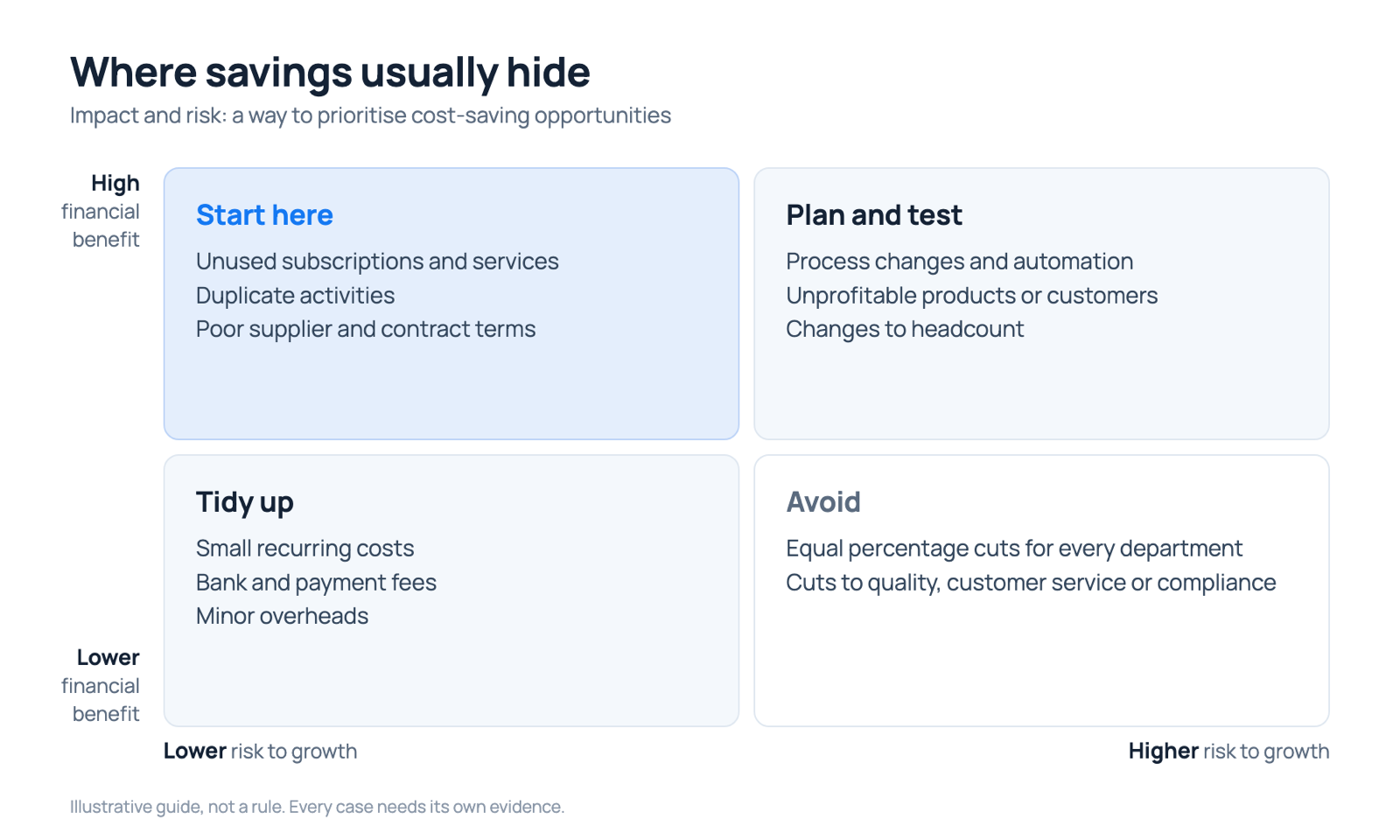
This prevents the business from treating all costs in the same way. Expenditure that protects revenue, safety, quality or critical operations should be approached differently from unused subscriptions, duplicated activities or poorly negotiated supplier contracts.
Look for waste before reducing capability
The safest savings usually come from eliminating waste and inefficiency rather than weakening the company’s ability to deliver. Common areas of unnecessary expenditure include:
Unused services and subscriptions
Businesses often continue paying for software licences, memberships, storage facilities or professional services that are no longer fully used. These expenses may appear individually insignificant but can become material when combined.
Duplicate activities
Different departments may purchase similar services, maintain separate databases or prepare overlapping reports. Consolidating these activities can reduce both cost and workload.
Poor supplier and contract terms
Long-standing supplier relationships should still be reviewed periodically. Pricing, minimum purchase requirements, automatic renewals, payment terms, service levels and termination clauses may no longer be competitive or suitable.
The solution is not always to replace the supplier. Renegotiating the scope, volume commitment or payment structure may produce savings while preserving a valuable relationship.
Inefficient processes
Manual data entry, repeated approvals, unnecessary reporting and unclear responsibilities consume employee time. This cost may not appear as a separate line in the financial statements, but it reduces productivity and delays decisions.
Before reducing headcount, management should examine whether better processes, clearer ownership or appropriate automation could release capacity.
Unprofitable products, customers or activities
Revenue does not always mean profit. A product or customer may generate strong sales but require excessive discounts, delivery costs, support time, financing or customised work.
Profitability should therefore be assessed at an appropriate level — by product, customer, service, location or sales channel. This can reveal where the business is using resources without receiving an adequate return.
Protect the drivers of growth
Before approving a saving, management should consider its impact on the areas that support future performance. These normally include:
- Product and service quality
- Customer experience and retention
- Revenue-generating employees
- Critical technology and operational systems
- Regulatory compliance and internal controls
- Maintenance of essential assets
- Development of strategically important capabilities
This does not mean that such areas should be excluded from review. It means that any changes should be based on operational evidence rather than a general percentage reduction.
For example, asking every department to cut spending by 10% may appear fair, but it ignores the fact that departments have different responsibilities, cost structures and growth potential. A targeted review usually produces better results than an equal reduction across the organisation.
Consider cash flow as well as profit
Cost optimisation should also improve the timing and predictability of cash flows. A company may be profitable but still experience liquidity pressure because customers pay slowly, inventory moves inefficiently or supplier payments are poorly scheduled. Management should therefore review:
- Customer payment terms and overdue receivables
- Inventory levels and purchasing practices
- Supplier payment terms
- Deposits and advance payments
- Loan interest, bank fees and foreign-exchange costs
- Timing of major purchases and investments
Improving working capital may relieve pressure without reducing expenditure that supports growth. In some cases, better collections or purchasing discipline will create more immediate value than cutting operating costs.
Prioritise opportunities by impact and risk
Once potential savings have been identified, they should be evaluated according to:
- Expected financial benefit
- Time required to achieve the saving
- Implementation cost
- Effect on customers and revenue
- Operational and compliance risk
- Ability to reverse the decision if necessary
Low-risk opportunities with a clear financial benefit can be implemented first. More complex changes should be tested carefully, with responsibility assigned to a specific manager.
Every approved initiative should have a baseline, a target, a deadline and a method for measuring the result. Otherwise, management may announce savings without knowing whether they were actually achieved or whether the cost simply moved elsewhere.
Cost optimisation should be continuous
The strongest businesses do not wait for a financial crisis before reviewing expenditure. They make cost management part of normal business planning.
Regular supplier reviews, profitability analysis, budget-versus-actual reporting and cash-flow forecasting allow management to identify problems earlier. They also make it easier to distinguish between a temporary cost increase and a structural inefficiency.
The purpose of cost optimisation is not to make the organisation smaller at any price. It is to ensure that the company’s resources are directed towards the activities that create the greatest value.
When this work is supported by reliable financial data, operational input and clear accountability, a business can improve profitability and cash flow without sacrificing the people, systems and customer relationships needed for future growth.
If you want an independent look at where your costs go and which savings are worth pursuing, our Business Cost Optimization Analysis looks at your largest cost areas and gives you written findings and recommended next steps.
This article is general business and financial guidance and does not constitute regulated tax or legal advice.