
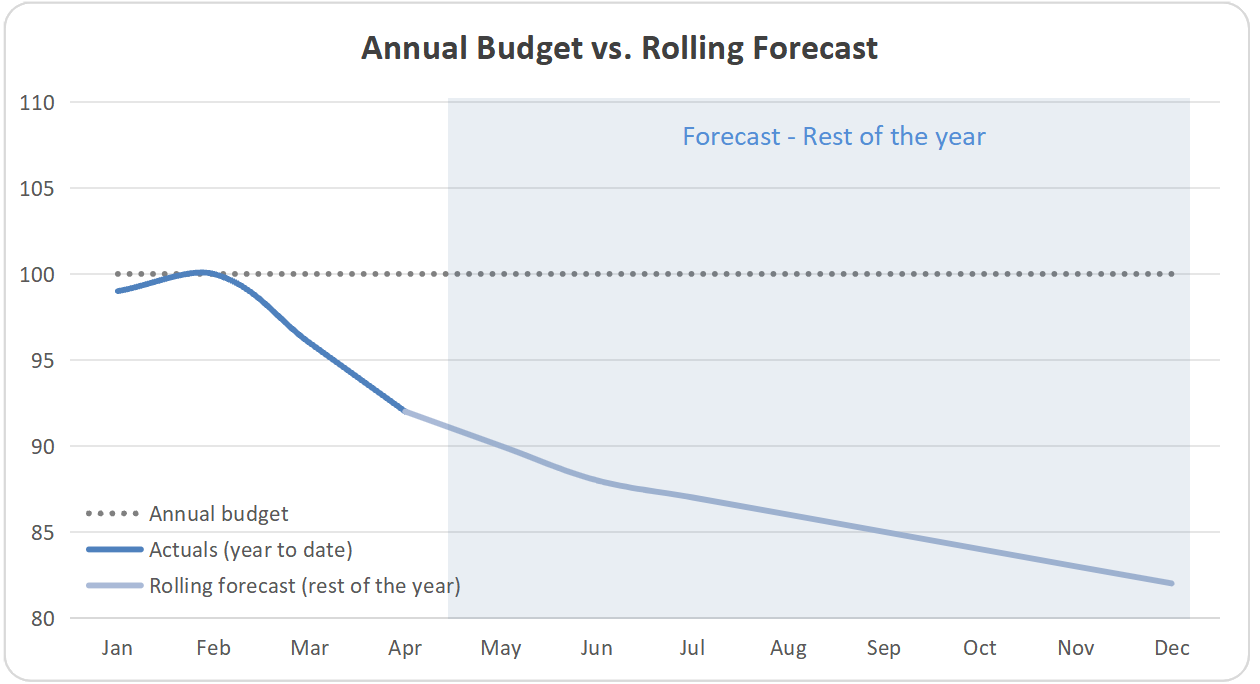
Most small businesses build a budget once a year, approve it with relief, and never touch it again. By February or March, the world has moved on: a supplier has raised prices, a channel has slowed, a product has run ahead. The numbers still look tidy, but they no longer tell the truth.
There is a straightforward fix: a rolling forecast, one of the most useful habits growing companies borrow from professional finance teams. You do not need a finance department — just an hour a month and a single page of numbers.
Why the annual budget breaks so quickly
An annual budget is a plan made with the information available at the time. It is a useful target, not a forecast, and it quietly assumes the next twelve months will look like the last twelve. For owner-managed businesses, that rarely holds. Things shift quickly:
- Sales change. A channel grows faster than expected, a large customer delays, or a new competitor appears.
- Costs change. Freight, materials, software, rent and payroll rarely stay where the budget set them.
- You change the business. You hire, launch a product, open a market or spend on marketing. Every decision rewrites the plan.
- The world changes. Currency moves, regulations shift, and energy or interest-rate costs change with little warning.
The budget is not wrong because anyone did a bad job. A snapshot taken months ago cannot describe a moving business. The danger is that owners keep comparing results to a stale number until, quietly, they stop reviewing it.
A rolling forecast keeps your view fresh for the rest of the year
A rolling forecast is a simple routine. After each month or quarter, you:
- lock the period that just ended as actuals; and
- refresh your best view of the rest of the year.
Monthly, that means locking January and revising February–December; quarterly, locking Q1 and revising the rest of the year.
A monthly cycle is the best default for most businesses, but the right cadence depends on your stage and industry. If you are early-stage, growing fast, or in a fast-moving sector such as e-commerce, internet or technology, conditions can change within weeks — update monthly. If the business is mature and in a stable industry, quarterly is often enough. Match the rhythm to how quickly your numbers actually move.
Crucially, you do not re-budget. The original budget stays as the agreed target. The forecast answers a different question: “Given what we know today, where are we heading?” It should drive decisions on hiring, stock, marketing, and cash.
The numbers that matter
A rolling forecast for a small business does not need to model every line. Four or five drivers explain most of the movement:
- Revenue, ideally split by the product, channel, or customer that makes it useful.
- Gross margin, how much of each sale is left after direct costs.
- Major fixed costs, usually payroll, rent, and the few subscriptions that dominate spending.
- Cash, because profit and cash differ; a growing business can be profitable and short of cash at once.
- One or two operational drivers, such as headcount, order count, average order value, or the cost of acquiring a new customer.
Keep it simple enough for a non-financial owner to read in two minutes. The goal is not to build a perfect model, but to notice the direction of travel early, while there is still time to act.
You can start in about an hour
A basic first version fits on one spreadsheet tab:
- Open the current fiscal year by month — one column per month, one row per line item.
- Enter the year-to-date actuals. Use real numbers, not hopes, for every completed month.
- Project the remaining months with your best honest estimate. Base revenue on current order books and trends; base costs on known contracts and commitments.
- Lock the month that just ended as actuals and refresh the estimates for the months still ahead. Write two or three sentences explaining what changed and why.
- Flag the differences that matter. If revenue, margin or cash is tracking materially off plan, decide on one action rather than merely describing the gap.
| Actuals (Jan–Apr) | Estimate: rest of the year (May–Dec) | |||||||||||
|---|---|---|---|---|---|---|---|---|---|---|---|---|
| Line item | Jan | Feb | Mar | Apr | May | Jun | Jul | Aug | Sep | Oct | Nov | Dec |
| Revenue | 120 | 125 | 130 | 128 | 132 | 136 | 140 | 144 | 148 | 152 | 158 | 164 |
| COGS | 70 | 73 | 77 | 77 | 79 | 82 | 84 | 85 | 87 | 88 | 92 | 93 |
| Gross margin (%) | 42 | 42 | 41 | 40 | 40 | 40 | 40 | 41 | 41 | 42 | 42 | 43 |
| Payroll | 48 | 48 | 50 | 50 | 50 | 52 | 52 | 52 | 54 | 54 | 54 | 54 |
| Rent | 12 | 12 | 12 | 12 | 12 | 12 | 12 | 12 | 12 | 12 | 12 | 12 |
| Subscriptions | 6 | 6 | 6 | 7 | 7 | 7 | 7 | 8 | 8 | 8 | 8 | 8 |
| Cash at month-end | 210 | 230 | 245 | 235 | 240 | 245 | 255 | 265 | 280 | 295 | 320 | 345 |
| New customers | 180 | 190 | 205 | 198 | 210 | 220 | 230 | 240 | 245 | 250 | 260 | 270 |
The written sentences are the most valuable part. A forecast that changes with no explanation teaches you nothing. A short note — “acquisition cost rose after the paid channel repriced in March” — turns it into a record of what the business is learning.
What a rolling forecast actually changes
The point is not better paperwork; it is earlier, calmer decisions. A forecast turns a surprise into an early signal, so you see problems months earlier:
- A cash gap arrives before the bank statement does. If your forecast shows a cash shortage approaching in October, you can take action in June instead of waiting until the problem occurs.
- A cost increase becomes a decision, not a fact. When software or freight costs rise for three months, the trend is visible and the renegotiation or consolidation conversation happens early.
- Growth stops hiding problems. A rising top line can mask shrinking margins and rising acquisition costs; a monthly forecast puts margin and cash next to revenue.
Larger companies use the same discipline; the spreadsheet is just smaller.
Why you still want a budget
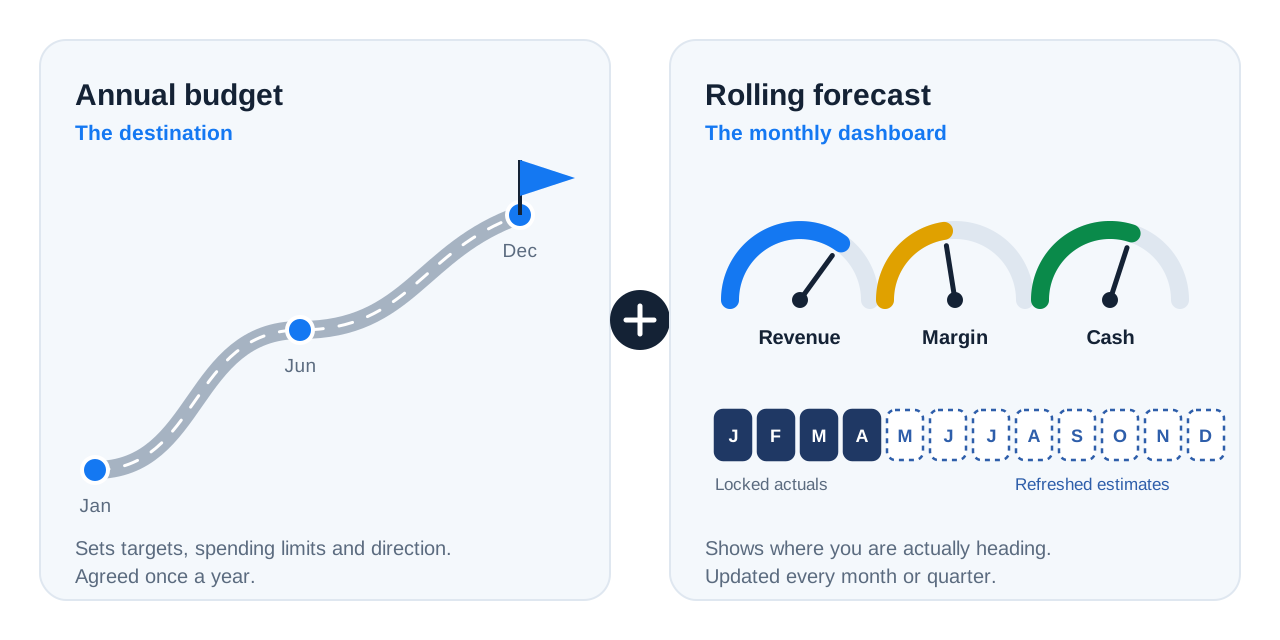
None of this makes the annual budget useless. It still has a clear job: setting targets, aligning the team and agreeing spending limits, and giving leadership a big-picture moment to review the year and set next year's direction. The mistake is treating it as a forecast — comparing it against reality as if the world had stood still.
Keep both, but at their own levels: the budget is the annual, strategic destination; the rolling forecast is the operational counterpart that refreshes the numbers as the plan is executed and shows where you are actually heading.
A small, honest place to start
If you have never done this, set aside one hour before the next month-end and build the first version. It will not be perfect and does not need to be: after three months of real comparisons it will be genuinely useful. The hardest part is simply starting.
If you would like an independent view of how revenue, margin, costs and cash are tracking, you can book a Business & Tax Consultation (60 minutes) to talk it through.
A static budget tells you how the year was supposed to go. A rolling forecast tells you how it is actually going, soon enough to do something about it.
This article is general business and financial guidance and does not constitute regulated tax or legal advice.